

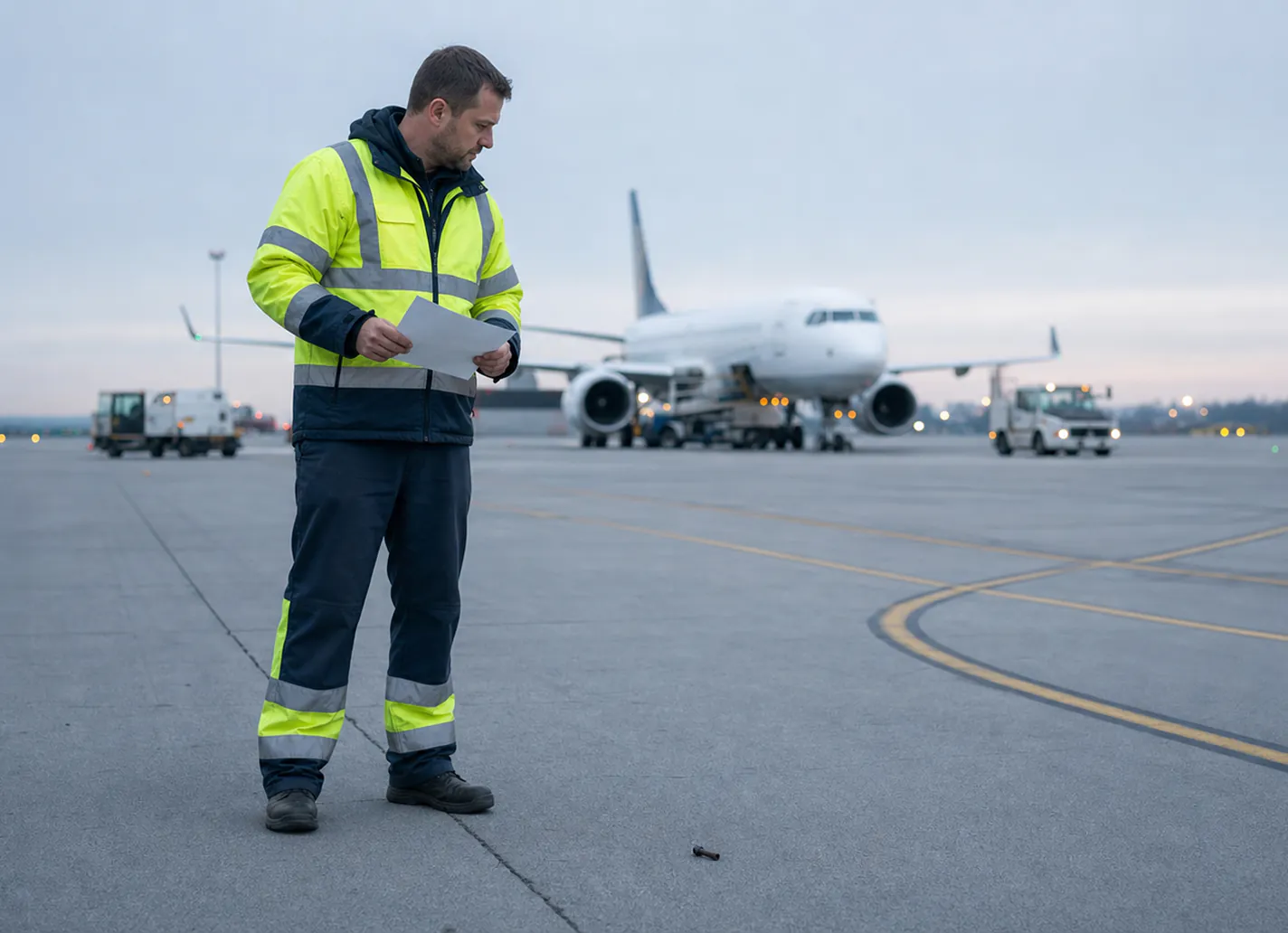
It’s 6am. A ramp agent spots Foreign Object Debris on the north taxiway. He fills in his paper form. The report reaches the operations director at 8am – two hours later. For two hours, aircraft have continued moving through that area.
This isn’t a hypothetical. It’s how the majority of regional and mid-sized airports in Europe actually operate today.
And it’s not a training problem or a motivation problem. It’s a structural one: field tools haven’t kept pace with the growth in air traffic.
A fast-growing sector, processes that haven’t changed
Global air traffic exceeded 9.5 billion passengers in 2024 – surpassing pre-pandemic levels. In Central and Eastern Europe, growth has been even sharper. Bucharest Henri Coandă Airport handled 17.7 million passengers in 2025, up 6.6% year-on-year, with departing seat capacity growing 28% between 2022 and 2026.
But while terminals fill up and frequencies increase, ground-level processes – inspections, maintenance, quality checks, intervention management – often still run on logic that’s twenty years old: paper checklists, shared spreadsheets, reports passed around by email.
The results are predictable. In 2025, IATA recorded more than 29,000 ground damage incidents involving aircraft worldwide, and nearly 38,000 loading errors. A significant share of these incidents trace directly back to failures in ground-level communication and documentation (Source: IATA Ground Operations, May 2026).
The Binder Bottleneck: when paper stops operations
There’s a well-known phenomenon in the sector: the Binder Bottleneck. Paper logs stay in the aircraft or on the ramp. Maintenance teams wait in the hangar with no real-time visibility into what’s happening in the field. The result: avoidable return-to-gate events and unplanned AOG (Aircraft on Ground) situations that can cost more than $10,000 per hour in disruptions, crew rescheduling, and passenger reaccommodation (Source: Datamyte, April 2026).
Even more striking: during an internal audit at a major US West Coast hub, 44% of ground support equipment failed inspection – not for mechanical reasons, but because of documentation gaps (Source: OXmaint, February 2026). The equipment was functional. The proof that it had been maintained was simply nowhere to be found.
This isn’t a discipline problem. It’s a system problem.
Three everyday field scenes every ops manager will recognise
Scene 1: The surprise audit An EASA inspector or internal auditor asks to review the maintenance history of a piece of ground equipment. The manager spends hours digging through binders, email threads and shared drives. The work was done – but the evidence is scattered.
Scene 2: The morning FOD A ramp agent spots an object on the taxiway at 6am. He fills out his paper report. It reaches the right person two hours later. In the meantime, no one was alerted in real time.
Scene 3: The equipment failure A baggage belt has been showing warning signs for weeks. Each technician logged their observations – in different formats, in different places. No one connects the dots. The failure happens on a Friday evening, at peak operational load.
These three scenes share one root cause: the field action is disconnected from its documentation.
What digitalisation actually changes
Airports that have implemented digital field management platforms report measurable results:
- 23% reduction in wait times for corrective action completion
- 16% improvement in overall operational efficiency
- Continuously audit-ready documentation, with no last-minute scramble (Source: OXmaint / Airport Inspection & Compliance, January 2026)
The aviation compliance monitoring software market reached $10.93 billion in 2024 and is projected to grow at 8.2% annually through 2033 – a clear signal that the sector’s digital transformation is well underway (Source: Airport Inspection & Compliance Management Platform, 2026).
But digitalisation doesn’t mean converting a paper form into a PDF. The real shift is linking every field action to its documentation in real time – so the intervention, the photo, the report and the attachment all live in the same place, accessible in seconds, not hours.
What we build at Datizy for multi-site operators
Datizy isn’t software designed specifically for aviation. It’s a field operations management platform for multi-site organisations – and airports are a natural use case: teams dispersed across a complex site, high traceability requirements, regular audits, and operational pressure that leaves no room for error.
Concretely, what we offer:
- Field inspections and checklists accessible from mobile, with or without connectivity
- Interventions directly linked to their documentation – photos, signed work orders, voice notes
- An audit-ready history retrievable in seconds
- And from Q3 2026, an AI Agent that automatically classifies, transcribes and structures field documentation
The goal isn’t to replace your teams. It’s to remove the administrative burden that slows them down – so they spend their time in the field, not on paperwork.
The right question to ask
It’s not “do we have the right tools?” Most airports have tools.
The question is:
do those tools talk to each other? Does the field action and its documentation live in the same place?
If the answer is no – and for the majority of mid-sized operators in Europe, it is – that’s where operational and regulatory risk is quietly accumulating.