

A few months ago, we had a pretty revealing conversation with a quality manager at an agricultural cooperative. He was overseeing around thirty sites and a team of field technicians, and he said something we haven’t forgotten: “The real problem isn’t that we don’t have the documents. It’s that we never know where they are when we need them.”
This isn’t an isolated case. It’s the daily reality for most field teams across Europe – in agriculture, food production, retail, and local government. And it’s exactly the problem we set out to solve.
Tasks and Documents: Two Worlds That Don’t Talk to Each Other
Here’s how things work in most multi-site organisations today:
A technician completes an intervention. They fill out their report on paper – or in a shared Excel if the company is “well-equipped”. The document ends up in a shared folder, with a naming convention that everyone interprets differently. Three weeks later, an auditor asks to see proof of that intervention. The manager spends two hours digging through nested folders.
This is normal. It’s accepted. And yet it is extraordinarily costly.
According to McKinsey, employees spend an average of 1.8 hours per day searching for information – nearly 25% of their working time (Source: McKinsey & Company, The Social Economy, 2012). A more recent study by Slite, surveying over 100 knowledge workers, confirms the loss amounts to more than one full month of work per person, per year (Source: Slite, Enterprise Search Survey Report, 2025).
And this isn’t just a productivity problem. In sectors like food and agriculture, documentary non-compliance has direct consequences. In 2024, more than 100,000 non-conformities were identified under BRCGS Food Safety Issue 9 audits, averaging 5 findings per audit (Source: Food & Drink International, March 2026). A significant share of these findings trace back directly to documentation traceability failures.
The Real Problem: The Disconnect Between Action and Its Record
The heart of the problem isn’t technical. It’s organisational.
When a task is carried out in the field – an inspection, a maintenance intervention, a quality control check – it naturally generates documentation: photos, work orders, intervention reports, certificates. But in the vast majority of companies, the task and its document live in completely different places.
The task is in a schedule, a CMMS, or in the team leader’s head.
The document is in SharePoint, a shared drive, or an email thread.
The result: reconstructing context takes time, errors creep in, and when an audit or incident occurs, no one can rebuild the full chain in real time.
IDC research estimates that companies lose up to 21.3% of their productivity due to document management issues – equivalent to roughly $19,700 per knowledge worker per year for organisations of 1,000+ employees (Source: IDC, Information Worker Survey).
What Changes in Practice: Task + Document in the Same Flow
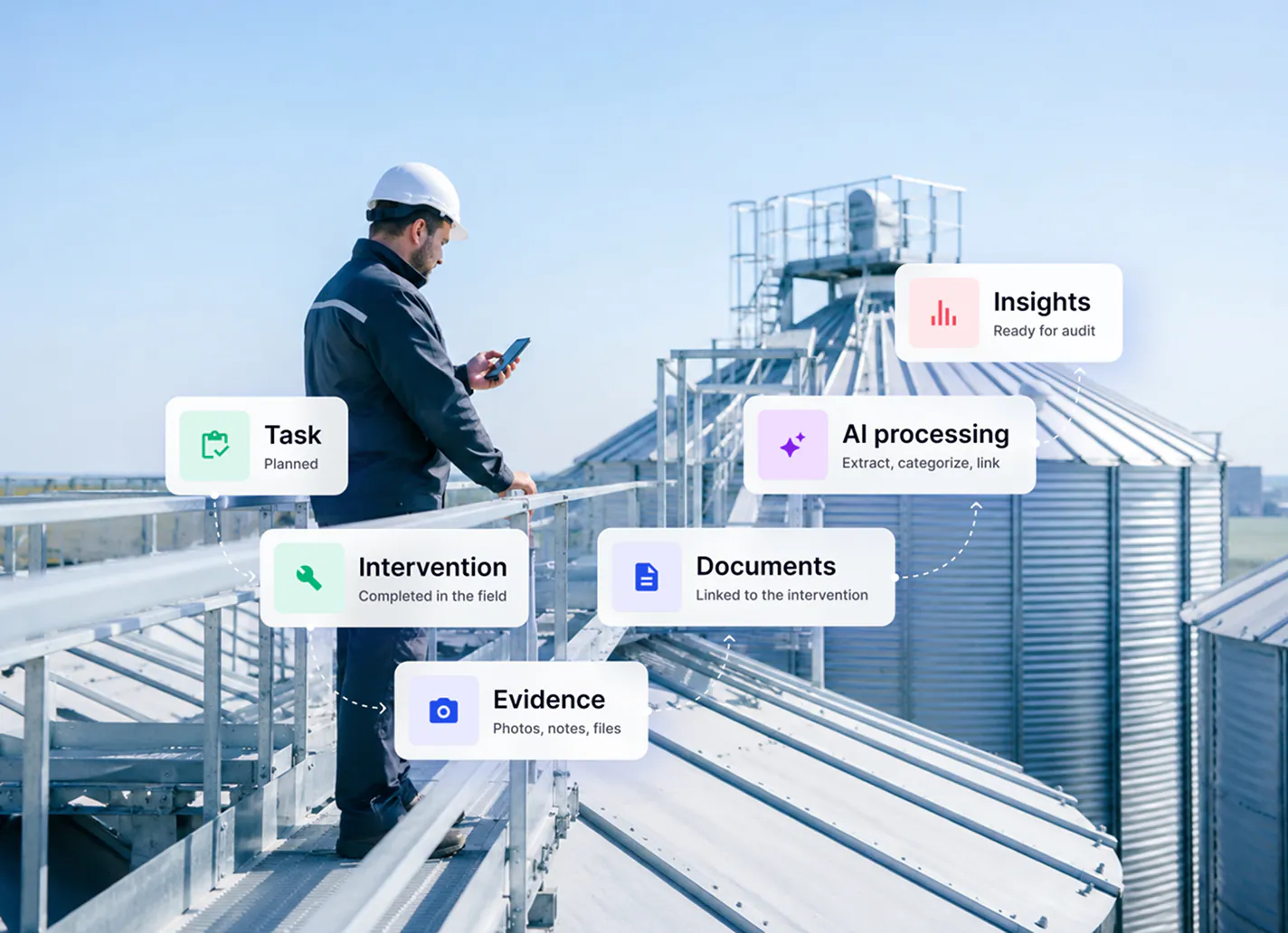
At Datizy, we’ve spent several months developing a different approach: directly linking documents to the tasks that generated them.
In practice, this means that when a technician closes an intervention in Datizy, they can attach the relevant supporting documents directly – a photo taken on-site, a signed work order, a PDF certificate. That document is no longer filed “somewhere” on a server. It’s linked to that specific intervention, that date, that site, that piece of equipment.
For managers and directors, this changes everything:
- During an audit: tracing an intervention takes seconds, not hours.
- After an incident: reconstructing the timeline is immediate.
- For reporting: data is already structured – no need to recompile.
We are officially launching our Document Management module in July 2026 – built natively into Datizy, linked directly to your existing tasks and interventions.
Now, AI Enters the Loop
The Documentation Management module would only be an incremental improvement if we stopped there. The real step change comes from what becomes possible once documents are linked to tasks: automated analysis.
That’s what our AI Agent will enable, from Q3 2026.
A few concrete examples:
- A technician photographs a paper document in the field. The AI agent extracts, identifies and automatically files it against the correct task.
- A manager dictates a voice note after an intervention. The agent transcribes it, structures it, and attaches it to the relevant intervention.
- When preparing for an audit, the AI agent can generate a documentary summary by site, by period or by intervention type – in seconds.
This isn’t science fiction. It’s the natural logic of a system where data is finally properly organised.
What Early Users Are Saying
We began rolling out these features with a number of clients during the pilot phase. The feedback is consistent:
“I wish I’d had this before.”
“Datizy makes data collection effortless – I get results instantly.”
These aren’t lines from a marketing deck. They’re verbatim quotes collected during our client workshop in May 2026.
What comes up consistently is always the same: fast adoption (field teams get up to speed within days) and immediate auditability (by the day after go-live, you can already reconstruct a clean history).
The Bigger Picture: Stop Treating the Document as an End in Itself
Traditional document management has long been sold as a solution. In practice, it’s often become just another problem: yet another system to feed, with its own conventions, its own logic, its own access rights.
The idea we champion at Datizy is different. A document isn’t a goal – it’s the natural outcome of a field action. If you organise the actions well, the documents follow. And once documents are properly linked to actions, intelligence can be applied to them.
That’s the shift in thinking that interests us. Not “where do we store the documents” – but “how do we make sure the document is already there, in the right place, at the right time, without anyone having to think about it”.